Heavy effort at low speed
Parking becomes harder when the pump fails, fluid runs low, the EPS motor weakens, or a rack bearing seizes.
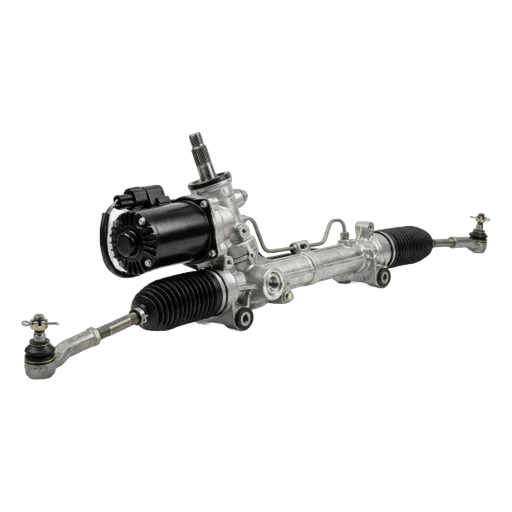
Our specialist facility in Al Quoz Industrial Area 3 handles every category of front-end and rack fault across the complete model range. The team delivers rack repairs, EPS motor diagnostics, linkage corrections, and precision calibration to restore factory-level control in each vehicle.
01Warning signs
Identifying system faults early reduces repair expenses by up to 35% compared to waiting until a component fails completely. These symptoms indicate a deeper mechanical, hydraulic, or electronic issue:
Parking becomes harder when the pump fails, fluid runs low, the EPS motor weakens, or a rack bearing seizes.
Air in the fluid, a strained pump, or a blocked high-pressure hose creates loud noise during rotation.
Worn tie rod ends, loose rack bushes, or damaged inner ball joints create loose movement felt at the wheel rim.
Uneven tire pressure, bad alignment, brake drag, or an internal rack fault shifts the vehicle off its centre path.
Voltage drops, sensor faults, EPS motor errors, or control unit bugs trigger warning lights that need scan-tool reading.
Warped brake rotors, out-of-balance wheels, worn control arm bushes, or a damaged shaft send shaking to the driver.
Stop driving and arrange recovery if the wheel becomes unresponsive or assistance drops suddenly while the vehicle is in motion.
02System types
Each model operates a different assistance configuration. Accurate fault isolation depends on identifying the fitted system before quoting replacement parts or labour.
Older Porsche Cayenne (2003-2010), Boxster 986/987, and 911 (996/997) models run a belt-driven pump pushing 80-120 bar through Pentosin CHF 11S fluid. Holding the wheel at full lock for more than a few seconds forces the pump against its relief valve and overheats the fluid. The 3 most common failure points are:
Current 911 (991/992), Macan, Cayenne (from 2019), Panamera, 718, and Taycan models use a brushless motor on the rack through a ZF parallel-axis drive. EPS cuts engine drag by 3-5 horsepower and allows software-tuned assist curves. Common fault sources are:
Select Porsche Cayenne and Panamera variants (2010-2017) use an electric motor to spin the pump instead of an engine belt. This preserves the hydraulic feel while eliminating belt-driven parasitic loss. Diagnosis requires checking both the electrical supply circuit and the hydraulic pressure output simultaneously.
03Services
Porsche steering linkage repair covers worn tie rods, drag links, and related hardware. Each part is checked for play, replaced, and realigned.
Worn ball joints and universal joints reduce turning control. Porsche steering joint replacement restores clean movement through factory-grade parts and set torque.
Cracked hoses or worn seals cause gradual fluid pressure loss. Porsche power steering fluid leak repair traces, isolates, and seals the source.
A sensor reset restores the link between EPS module and stability controls. Porsche steering angle sensor calibration follows rack or tie-rod work, an alignment, or a battery disconnection.
Faulty modules causing erratic assist or warning lights undergo testing. Porsche steering control module repair includes software reload or full unit swap.
Full tuning restores default assist maps, end-stop limits, and centre-point learning after changes. Porsche steering system calibration runs on factory-level scan tools.
Scan-tool reading pulls stored and pending codes from EPS and CAN-bus. Porsche steering fault diagnostics finds root causes before parts are quoted.
Grinding, whining, or clicking during turns traces to pumps, bearings, or column parts. Porsche steering noise diagnosis isolates the sound under load.
Shaking through the wheel stems from rotor wobble, balance problems, or worn driveshaft parts. Porsche steering wheel vibration diagnosis separates speed-linked oscillation.
Four-wheel geometry confirms toe, camber, caster, and thrust angle against factory targets. A Porsche steering alignment check follows rack or suspension repair.
Cayenne, Panamera, and Taycan rear setups use active assist for tighter turns, steering the rear wheels up to about 3° against the fronts at parking speed and with them at motorway speed. Porsche rear axle steering repair covers motors, sensors, and modules.
Failing pumps whine under load and lose pressure at low RPM. Replacement includes fresh fluid fill, full bleed, and a pressure test.
04Diagnosis
The table below maps each driver-reported symptom to its probable source area and the initial diagnostic checks performed during assessment.
| What You Notice | Likely Source Area | First Diagnostic Checks |
|---|---|---|
| Heavy at parking speed | Pump, EPS motor, fluid level, belt tension | Fluid level, leak check, voltage, scan data, motor response |
| Whine or groan on turns | Low fluid, air in system, pump strain, hose block | Fluid condition, leak tracing, pump noise under load, RPM test |
| Clunk or free play | Tie rod, rack mount, control arm joint, ball joint | Lift check, play reading, fastener torque, bush condition |
| Pulling or off-centre wheel | Tire pressure, alignment, ride height, brake drag | Pressure check, wheel alignment reading, angle data |
| Dashboard warning light | Battery voltage, wiring, sensor fault, control unit | Stored codes, live data stream, plug condition |
| Vibration through column | Rotor runout, wheel balance, driveshaft wear | Rotor reading, balance test, driveshaft play, U-joint check |
05Wear factors
Steady heat above 40°C breaks down hydraulic fluid, hardens rubber seals, and weakens surface coating bonds. Thinner fluid under heat cuts the protective layer inside the pump and rack assemblies.
Constant low-speed turning creates peak hydraulic demand on the pump and heavy torque on the EPS motor. Tie rod ends take repeated articulation stress during tight turns in parking areas.
Skipping fluid checks, letting small leaks go, and putting off alignment after tire work builds up front-end damage. Dirty fluid wears down seals faster and pushes grit into the system.
Hard hits from potholes and speed bumps send shock forces through the linkage and rack mounts. Bolts loosen over time and rubber bushes crack from repeated compression and rebound cycling.
Wrong-spec fluid harms seals, creates foam, and drops working pressure within months. Off-brand tie rods or rack boots that fall outside factory limits add play and speed up part failure.
A kerb hit bends tie rods, shifts the rack, and throws off knuckle angles in one moment. Even a light strike pushes toe off enough to cause uneven tire wear.
06Process
The technician records when the fault shows up, at what speed, and whether temperature changes it. Warning messages and prior service records are logged.
The vehicle goes on a lift for hands-on checks of rack travel, tie rod tightness, and bush condition. Play at the rim is measured.
Hydraulic setups get a pump pressure reading, fluid quality test, and leak trace. EPS units are checked through live data, motor current, and voltage.
Alignment angles are read and adjusted after any linkage or rack work. A road test confirms centring, noise absence, and straight-line tracking before handover.
07Handover
The finished Porsche repair includes verification checks beyond the primary repair to confirm the system operates as an integrated unit:
08Why us
Our dedicated team of 52 technical staff across mechanical, electrical, and body shop disciplines brings over 10 years of experience repairing German performance vehicles and their complex systems.
A 4.5 Google rating backed by 2,554 verified reviews reflects consistent service quality. Over 1,000 satisfied vehicle owners trust our facility for suspension, drivetrain, rack, and body repairs.
A 4,108 m² purpose-built facility with 18+ hydraulic lifts across dedicated service bays enables simultaneous diagnosis, mechanical repair, calibration, and alignment work without scheduling delays or vehicle shuffling.
Rack seals, pump assemblies, tie rod ends, and EPS motors match original equipment specifications for each model. OEM-equivalent parts and genuine components ensure fitment accuracy and long-term reliability.
Free pickup and drop-off by a dedicated driver accompanies every active service contract. A complimentary car wash is included with each completed repair alongside the documented service report.
Partnerships with 10+ insurance providers streamline claim-based repairs and reduce owner out-of-pocket costs. A dealership-alternative service contract covers scheduled maintenance, unexpected repairs, and priority booking without franchise-level pricing.
09Book
Call or send the model year, mileage, and fault details via WhatsApp to book a focused assessment slot. The team sets up the right scan tools for the fitted system and sends a written quote based on the confirmed fault before any work starts. Let us know whether the vehicle can be driven in or needs a pickup.
10FAQs
Straight answers before you book. Still unsure? Ask the service advisor.
Ask a questionA diagnosis runs AED 350-650. Fluid service is AED 300-800, alignment AED 400-1,200, linkage AED 1,000-3,500+, pump swap AED 1,500-4,500+, and rack work AED 3,500-7,000+.
Less assist or sudden changes in wheel response means it is time to stop safely. Book an assessment instead of hoping the warning goes away on its own.
Assist demand is highest at low speed. Low pump output, low fluid, EPS motor strain, or stiff joints all become more clear during tight slow turns.
Not always. Tire pressure gaps, brake drag, bad alignment, and worn arms can cause the same pull. These are ruled out first before the rack is blamed.
Some units take a rebuild when the housing and bore are still within limits. Racks with motor or sensor faults usually need a full swap instead.
Electric steering protects its motor by reducing assist when it gets hot, so repeated full-lock turns on a 45°C day can make the wheel feel heavier for a few minutes. If the weight stays or a warning appears, the motor, sensor or wiring needs testing.
No. Fully electric setups use a motor and need no fluid at all. Some older models with a hybrid electric-hydraulic layout do still use fluid.
Any job that shifts toe angles is followed by a four-wheel alignment. Electric models also get an angle sensor reset as part of the finished work.
Share the model, year, mileage, any warning message, and when the fault happens. Note recent tire work, alignment, battery changes, or any past impact.